|

Nehemiah
Anchored Earth (AE) wall was first introduced in Malaysia in 1993.
Since then, it has gained wide acceptance not only in Malaysia but
oversea as well. The technology has been exported to Singapore and
India. Todate over 700,000 m2 of walls has been built with varying
heights, configurations and applications. The highest wall that
has been built so far todate is 20.5m. The reasons for the popularity
of the Nehemiah wall are cost effectiveness, versatility, excellent
performance, attractive appearance, and speed of construction. The
Nehemiah wall is applicable in a wide range of situations.
These applications include :
Urban
Highway Interchanges
Of all the various applications,this category of application is
the most popular. This is because the Nehemiah wall is ideal for
fill situation which is true for most of the highway interchanges.
Construction is rapid and the interference with the vehicular traffic
is minimised due to the "erection from behind" method
implemented. The large number of Nehemiah walls used for the Kuala
Lumpur Middle Ring Road II project is a testimony of their popularity.
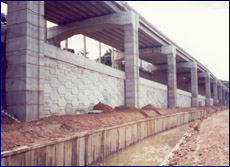
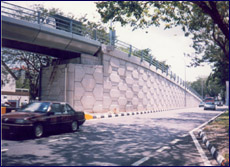
The SPRINT expressway project in Kuala Lumpur (Photo 1) and the
Autopont Bridge project along Jalan Masjid Negeri in Penang (Photo
2)clearly illustrate the application for urban highway interchanges.
The next application is also related to highways but those found
in mountainous region instead.
|
|
|
|
Photo
1 : Sprint Expressway, Kuala Lumpur |
Photo
2 : Autopont Bridge along Jalan Masjid Negeri, Penang |
back to top <
Mountainous Highways
An example of this application is found in the Kuala Lumpur- Karak
Highway,Second East West Highway crossing the main range from Simpang
Pulai near Ipoh in the west to Kuala Berang,Trengganu in the East.
A typical cross-section is shown in
Figure 1.
It is seen that the reinforcing
bar length is shorter at the lower portion of the wall. This design
configuration is important in order to minimise the amount of excavation
there by resulting in cost saving. In addition, deep excavation
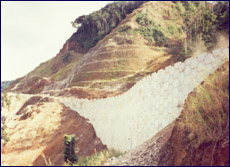
into hillside can trigger slope stability problems. Photo 3 illustrates
the difficult mountainous terrain that the construction of the Nehemiah
wall has to overcome.
|
|
|
Photo 3 :
PosSelim - Simpang Pulai Expressway |
Another challenging situation for the application
of Nehemiah Wall is the river which is subjected to erosive effect
of water and floods.
back to top <
River
Wall
The design of Nehemiah wall for river application is a different
ball game altogether. The design has to cater for the hydraulic
head differential during rapid draw down condition. In addition,
the toe of the wall need to be protected from the effects of scouring.
The bouyancy and seepage forces has to be factored in during the
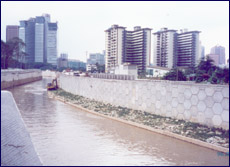
design computation as well. Photo 4 illustrates the use of Nehemiah
wall for the widening and deepening of the Klang River.
The wall is designed to withstand floods whereby the wall is submerged.
Another challenging application is when there is a landslide.
|
|
|
Photo 4 :
Sg. Klang River Wall, Kuala Lumpur |
back to top <
Slope Repair
Unlike river wall or highway application,the magnitude of this type
of application is relatively small. But they are often critical
and urgent. The approach to solve the slope failure problem is to
use Nehemiah wall as a gravity buttress at the toe to provide stability.
A typical cross-section is as shown in Figure
2. Besides slope repair, Nehemiah walls can also be used for
railway application.
back to top <
Railway Embankment
The requirements for railway application are similar to highway
application except that the settlement criteria for railway is more
stringent. In addition, the dynamic force due to vibration from
the rail need to be considered. A typical cross-section of the railway
embankment is shown in Figure3.
An integral part of the railway and highway approach embankment
is the bridge abutment. Nehemiah wall also find it application in
this situation.
back to top <
Bridge
Abutment
In this application,the bridge loads are often transferred to the
bank seat which is in turn supported by piles as shown in Figure
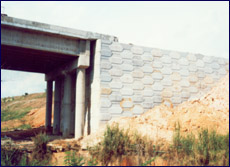
4. Photo 5 illustrates the bridge abutment where by the bridge
loads are supported by external columns.
Under this circumstance, the Nehemiah wall is acting merely as a
retaining wall. If the subsoil's sufficiently strong, the Nehemiah
wall can be designed to be load bearing and carry the bridge load
directly. Perhaps, the most straightforward application of the Nehemiah
wall is found in housing development.
|
|
|
Photo 5 : Bridge Abutment at Nilai Perdana,
Negri Sembilan |
back to top <
Housing Development
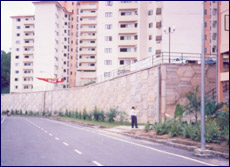
Nehemiah wall has been used for housing development to gain useable
land especially in urban areas where the land cost is high. In rural
areas where the land cost is low, it is cheaper to use earth slope
instead of a retaining wall.
|
|
|
Photo 6 : Kurnia Perdana Condominium at Kota Kinabalu,
Sabah |
back to top <
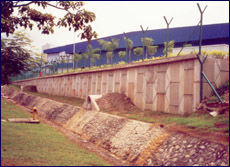
Industrial
Development
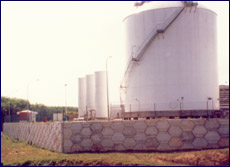
Besides housing, industrial development also constitute a significant
demand for Nehemiah wall. Photo 7 shows an application for a LNG
tank farm and Photo8 shows an application for a factory in Senawang.
|
|
|
|
Photo
7 : Kulim Hi-Tech Park, Kedah |
Photo
8 : Goodmaid Chemical Factory at Senawang, Negeri Sembilan. |
back to top <
Conclusion
From the above brief description, it is seen that Nehemiah wall
is versatile and can be applied in a wide variety of situation in
the most economical way.
|